Safety Shoes in India: Complete Buyer Guide
Last Updated on June 16, 2026
Over 2.3 lakh workplace foot injuries are reported every year in Indian manufacturing units – most of these could be avoided with the right kind of footwear. The manufacturing, construction, mining, logistics and chemical processing industries are particularly at risk, and purchasing safety shoes that meet the necessary standards is crucial for looking after workers and keeping on the right side of the law. That’s why IndustryBuying has a huge range of certified safety
shoes from over 40 brands in every industry – over 500 models to be precise. This guide has all the safety shoes you’ll ever need, a rundown on the IS 15298 standard, a guide to matching the right shoe to the right hazard, and a look at what bulk pricing looks like these days.
What Are Safety Shoes? Definition, Purpose & IS 15298 Standard Explained
Safety shoes – as the name suggests – are basically just shoes that are designed to stop you getting injured at work. They are made to protect from things like falling objects, sharp tools, electrical hazards, chemicals and slippery floors – all the kind of dangers you might encounter in a hazardous environment. They’re put through their paces to make sure they meet safety standards, which is just what you want if you’re working in a place that’s a bit of a risk.
In India, the key standard for safety shoes is IS 15298. This is the one all factories, construction sites, mines, and other workplaces look to when it comes to safety requirements for industrial footwear.
IS 15298 vs EN ISO 20345
| IS 15298 (India) | EN ISO 20345 (Europe) |
| Indian safety footwear standard | European safety footwear standard |
| BIS certification | European certification |
| Used across Indian industries | Used across EU industries |
| Covers toe impact and compression protection | Covers toe impact and compression protection |
| Supports Indian compliance requirements | Supports European compliance requirements |
Who Needs Safety Shoes?
Safety shoes are a must under various laws and regulations, including the Factories Act and construction safety rules for:
- Manufacturing plants that are always at risk from equipment and moving parts
- Construction sites where there’s a constant risk of drops from height
- Mines which are a high risk environment
- Warehouses and logistics facilities where you’re always moving heavy gear around
- Chemical processing units where you might encounter nasty chemicals
- Engineering workshops where you’re working with power tools and heavy equipment
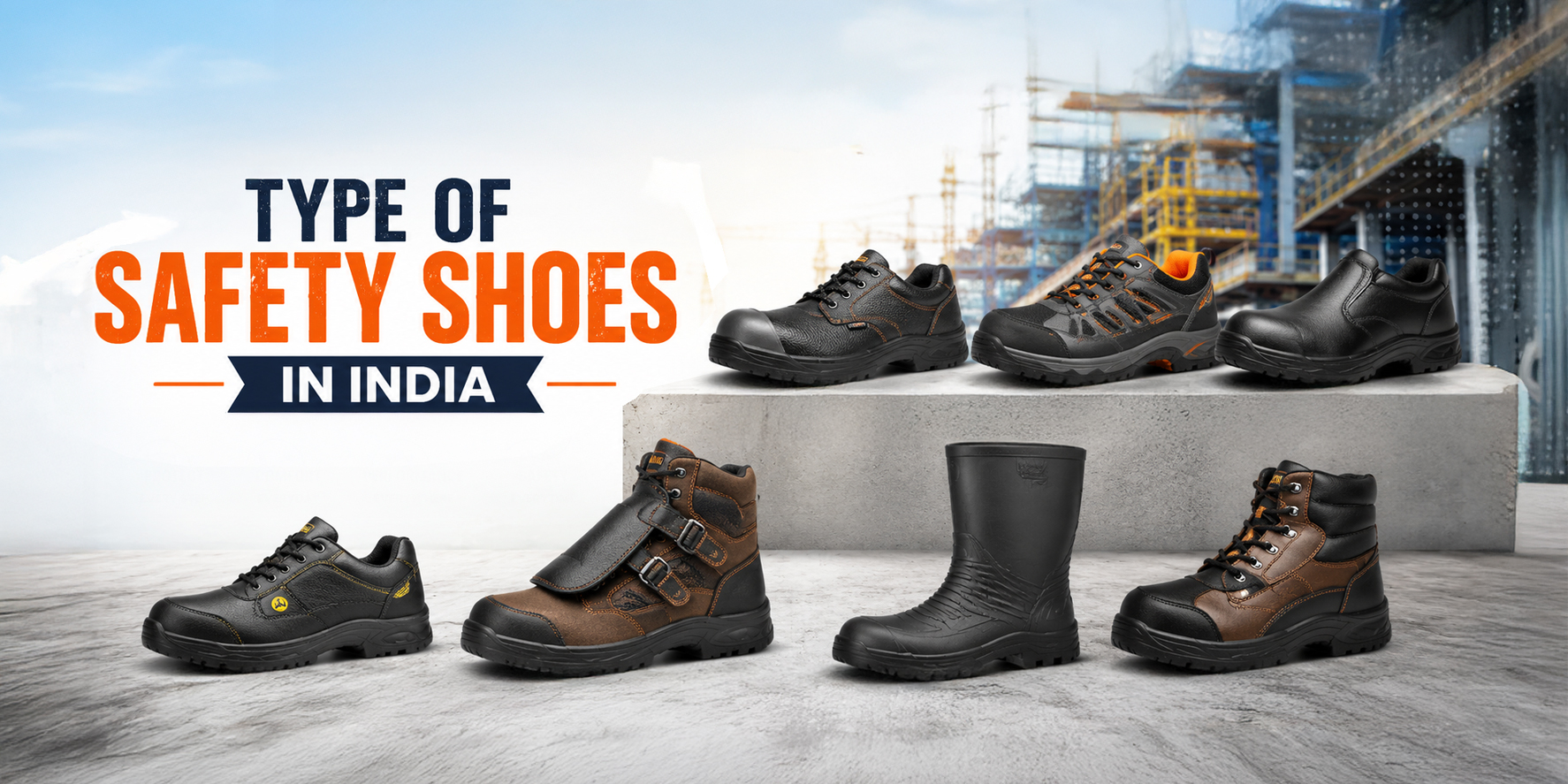
Types of Safety Shoes: Which One Is Right for Your Workplace?
Choosing the Right Safety Shoes – It Depends On What Hazards You’re Up Against in the Workplace
Steel Toe Cap Safety Shoes
Steel toe cap shoes do a great job of protecting you from really heavy falling objects and the pressure of something sitting on your foot. They are super popular in construction, warehousing and heavy manufacturing. They basically are a no-brainer for a lot of workplaces.
Best suited for: Any workplace where you might get hit with a heavy object, especially construction, fab shops and manufacturing
IS Standard: IS 15298 certified – which is a well respected mark
Price Range: Expect to pay from roughly 700 to 3,500 rupees
Composite Toe Cap Safety Shoes
Composite toe shoes use materials like fiberglass or Kevlar instead of metal. Resulting in shoes that are way lighter than steel toe shoes, and also suitable for super sensitive electronics work.
Work best in: Electronics plants, airport areas, and super clean rooms – where even a tiny shock can ruin millions of dollars worth of equipment
IS Standard: IS 15298 certified – same as the metal ones
Price Range: Expect to pay from 1200 to 5,000 rupees
Anti-Slip & Oil-Resistant Safety Shoes
These shoes are perfect for workplaces where floors are slippery – they provide extra grip on the floor to prevent slips and falls.
Work well in: Food processing, kitchens, and chemical plants – these are places where slips are a major risk
IS Standard: If you are looking for the slip-resistant version, be sure to get one with an IS-certified slip resistant sole
Price Range: Expect to pay from 800 to 3,000 rupees
ESD Safety Shoes
ESD safety shoes are made to safely dissipate static electricity and protect all that delicate electronics equipment.
Best for: Electronics, semiconductor plants, and super clean cleanrooms – all places where the slightest spark of static electricity can be a disaster
Price Range: Expect to pay from 1,500 to 6,000 rupees
Metatarsal Guard Safety Shoes
Extra protection for the top part of your foot. Not that you are going to forget to buy a good toe cap, but these go further than that.
Best suited for: Foundries, steel plants, metal fabrication – places where your feet are under huge pressure
Price Range: Expect to pay from 2000 to 7,000 rupees
Chemical-Resistant Safety Boots
A must for workplaces that deal with acids, alkalis, and other chemicals – designed to withstand the rough stuff.
Best for: Chemical plants, water treatment facilities, and sewage plants – places where chemicals are a major risk factor
Price Range: Expect to pay from 500 to 4,500 rupees
| Type | Best Industry | IS Standard | Price Range (₹) |
| Steel Toe | Construction | IS 15298 | 700–3,500 |
| Composite Toe | Electronics | IS 15298 | 1,200–5,000 |
| Anti-Slip | Food Processing | IS 15298 | 800–3,000 |
| ESD | Electronics | IS 15298 | 1,500–6,000 |
| Metatarsal | Foundries | IS 15298 | 2,000–7,000 |
| Chemical Boots | Chemical Plants | IS Certified | 500–4,500 |
How to Choose Safety Shoes: A 5-Step Checklist
1. Identify Workplace Hazards
Determine whether workers face mechanical, electrical, chemical, thermal, or slip-related risks.
2. Verify Compliance Requirements
Check industry-specific regulations and ensure the footwear meets IS 15298 requirements.
3. Match the Shoe Type to the Hazard
Use steel toe shoes for impact protection, ESD shoes for electronics facilities, and chemical-resistant boots for corrosive environments.
4. Prioritize Worker Comfort
Employees working 10–12 hour shifts need lightweight, breathable, and ergonomically designed safety shoes to improve compliance and productivity.
5. Consider Total Cost of Ownership
Don’t focus only on purchase price. Consider replacement cycles, durability, productivity, and potential injury-related costs.
Pro Tip from IndustryBuying’s sourcing team: Always request a sample pair before placing bulk orders of 100+ units.
Top Safety Shoe Brands Available in India
| Brand | Price Range (₹) | IS Certified |
| Karam | 800–4,500 | Yes |
| Acme | 700–4,000 | Yes |
| Safari Pro | 600–3,000 | Yes |
| Vaultex | 900–5,000 | Yes |
| Allen Cooper | 1,200–6,500 | Yes |
| Bata Industrials | 1,000–6,000 | Yes |
Karam is a preferred choice for construction and infrastructure projects due to its reliable quality and wide product range.
Safari Pro offers excellent value for organizations looking for budget-friendly safety shoes.
Allen Cooper is known for superior comfort and is ideal for workers on long shifts.
Vaultex is popular among manufacturing companies seeking durable industrial footwear.
Get a Bulk Quote for Your Team
Conclusion
The right safety shoes do much more than meet compliance requirements-they help reduce injuries, improve worker productivity, and lower long-term operating costs. Before purchasing, assess workplace hazards, verify IS 15298 certification, and choose footwear that balances protection, comfort, and durability.
FAQs
The primary Indian standard is IS 15298, which specifies requirements for impact resistance, compression resistance, slip resistance, and overall safety performance for industrial footwear.
Safety shoes usually cover below the ankle, while safety boots provide additional ankle protection and are preferred for construction, mining, and chemical environments.
Steel-toe shoes can trigger metal detectors. Composite toe safety shoes are generally preferred in airports and security-sensitive facilities.
Most safety shoes last between 6 and 18 months depending on working conditions, usage frequency, and exposure to hazards.
MOQ varies by brand and size requirements. Standard models often have low MOQs, while branded orders require higher quantities.
Safety shoes in India typically range from ₹500 to ₹6,500 per pair depending on the safety features, certification level, and brand.